
Note: this review spoils important plot points in the film.
It took some time for Roma‘s true intentions to sink in: on my first watch, I was so lost in the film’s intimate, unbroken depiction of one family’s life that when it erupted into violence and chaos, I was shocked. But maybe that’s the point. Roma doesn’t announce itself as a historical film (or even an overtly political one); in fact, director Alfonso Cuaron based it primarily on childhood memories of his own caretaker, Libo. For most of its running time, it focuses on cleaning dog poop, resolving disputes over toys, and the other slice-of-life drama that occupies live-in housekeeper Cleo, along with the four children and family she works for. But as it progresses, it reveals deeper themes about how political strife, whether we choose to focus on it or not, disrupts everyday people’s lives – and how it can inspire families to come together, even in the wake of grief and loss.
The film takes place in Mexico City between 1970 and 1971, but reveals its historical context subtly: in one of the first scenes, one of the boys sits at the kitchen table, sharing an anecdote of a classmate throwing water balloons at passers by…until a soldier in a tank shoots him in the head in response. This story is recounted casually, as if a story about a playground fight, highlighting how normalized it has become even for children in the city. Later, we see the emergence of activism, when patriarch Dr. Antonio leaves for a conference, his car literally cutting through a crowd of demonstrators. In the film’s most climactic scene, Cleo and the family shopping for her newborn child’s crib gets disrupted by the Corpus Christi massacre, a real-life incident in which over 100 demonstrators were killed by a Mexican paramilitary squad. As political unrest escalates, it becomes more and more difficult for everyday people to look away – and ultimately, it costs Cleo her baby, as she miscarries due to the stress being held at gunpoint (by her former lover, no less) induces.
Yet Roma develops this theme of political disruption in tandem with broader themes of family and belonging. As housekeepers, Cleo (and her colleague Adela) occupy a tenuous space within the family structure: though Cleo is arguably the closest with the family’s four children, she is also in a servant role. Early on in the film, there’s a shot of the entire family together, watching TV. Initially Cleo is on the edge, gathering empty plates, but then the youngest son, Pepe, puts his arms around her, and for a moment, she is included. Only moments later, however, Sofia, the matriarch, asks her to bring tea: despite the kids’ protests, Cleo complies, quietly returning to her role. Yet there are also moments of care, however imperfect: just as Cleo sings to the kids when it’s time to sleep or wake up, Pepe sings for her when she is upset about her pregnancy, and though the grandmother may not know Cleo’s middle name, birthday, or personal information, she tearfully does her best to help her when she is about to give birth. By the end of the film, Cleo may still be in a subjugated role, but her role in the family has become more recognized and respected by all members of the family.
One of the most interesting relationships evolves between Cleo and Sofia. Initially, Sofia is cordial but distant to Cleo, maintaining a traditional client-servant relationship. However, as Sofia’s marriage deteriorates in her husband’s absence (and as she tries and fails to hide this reality from the kids), she takes her anger out on Cleo, berating her for not “cleaning up the dog shit” and blaming her for letting eldest son Paco spy on his mother as she cries about his abandonment. Despite this power differential, however, a strange solidarity emerges between these two women: in her lowest moment, a drunk Sofia returns home and tells Sofia that “women are always alone,” a message the film reinforces both through its male characters and its allusions to other visual media. Whenever Dr. Antonio arrives home, for instance, the film shows his car before it shows him: its headlights glare into the screen, as if an alien threat, and we see his newspaper, cigar, and hat before ever seeing his face, clearly showing how he himself puts these symbolic manifestations of male power before his humanity. Cleo’s boyfriend, Fermin, falls into similar thinking: in his first scene, he claims he “owes [his] life to martial arts,” explaining how it saved him from a life of poverty and addiction through discipline and focus. But when Cleo tells him she’s pregnant, he uses his seeming dedication to this life as justification to abandon her – in fact, he escalates his violence, threatening to beat her and her unborn child should she ever approach him again. Even the film’s allusions to popular television and film of the period suggest that the media conditions men to value certain narrow forms of strength and power: while Adela and Cleo discuss “pushy” boys who don’t understand boundaries, we see a martial arts TV show featuring a man dragging a car with his mouth, and later, Cleo catches two of her boys looking at porn magazines of women moments after Dr. Antonio darts in and out of the frame, cheating on his wife with another woman. In this social context, Sofia’s statement to Cleo is no surprise: in a world where men are enabled and rewarded for chasing after their selfish worldly ambitions, it’s women who are left to pick up the broken pieces and carry their households forward. Ultimately, it’s this solidarity that enables Cleo and Sofia to connect during the film’s climax, as Cleo tearfully confesses she didn’t want her child and Sofia vocally affirms her belonging in this family. Though they may not hold the same power in society, they come to support each other as women navigating patriarchal systems.
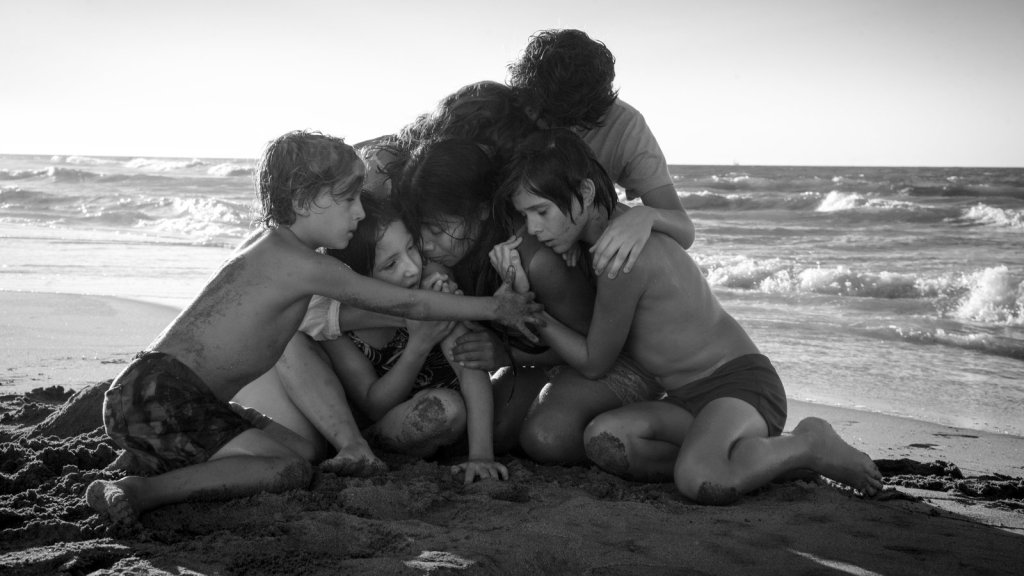
Beyond its nuanced, thoughtful depictions of its characters, Roma also utilizes visual language and metaphors to convey its themes. Most striking is director Alfonso Cuaron’s use of black-and-white throughout the entire film: knowing that Cuaron based Roma‘s story off of his own experiences with his own caretaker, this choice creates a sense of affection and nostalgia, as if viewers are looking into old family archives and recounting childhood stories. On the flip side, however, this choice also creates critical distance between the film and viewers: because we don’t see the shades of blue in the sky (or the color of Borras’ dog shit), we cannot take the film at face value as a 100% accurate retelling, pushing us to think more critically about how the film frames (and juxtaposes) personal and political events. Our memories of past events are shaped by the knowledge and insight we gain from reflection, and Cuaron’s depiction of his own childhood via Roma is no different. Beyond the choice of black-and-white, Cuaron also utilizes water as a metaphor for the fluidity of memory: the film opens with close-up shots of water washing over the house’s floor, with brief glimpses of planes flying over Cleo’s head, only for the reality of her labor and responsibility to wash over this historical context. For Cleo, there is no time to ruminate on how her life fits into a larger historical puzzle. There is dog shit to clean. Yet the film ends, too, on water: the waves that Cleo must wade into in order to save two of Sofia’s kids from drowning. Though in one unbroken shot, we see Cleo’s courage as she braves the ocean to pull Paco and Sofi free, the water is so choppy that it breaks over the camera lens on multiple occasions, obscuring our view. In this shot, what Cuaron is trying to convey makes sense: no film he could make would have the ability to convey perfect historical truth. As viewers, we don’t get to see everything exactly how it happened; there will always be the moments in which the image was interrupted. All he can do is focus on the humans who helped him live through some of his country’s most challenging times and hope we can put together the pieces of the story. Cleo, in an act of selflessness and love, rescues these children who, somehow, have become her family…and because of her sacrifice, they will survive to tell her tale through their eyes.
 Mo Kim
Leave a comment