
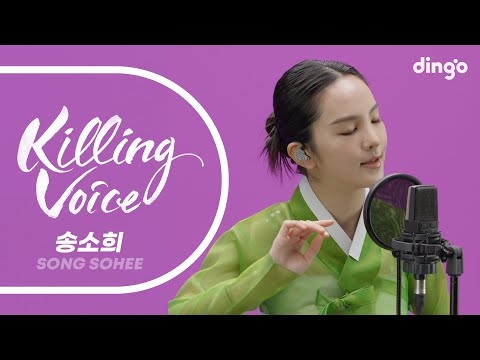
Before South Korean folk musician Song Sohee sings a single note, she introduces herself to the audience with a joke: “It’s your first time seeing somebody on this channel in a hanbok, huh? It’s my first time here, too” (Song). This joke highlights the unexpected space between folk musician and pop star that Song has come to occupy: known in South Korea as the “Traditional Music Girl” since winning a national singing contest in 2008 (at the age of ten), she’s since become one of the nation’s most successful folk artists. With great power, however, comes great responsibility. Song’s growing popularity from live performances and television soundtracks has empowered her to further Korea’s musical heritage via platforms that typically cater to younger audiences. Perhaps the best example of her impact is her 2023 concert, which she released on March 1 (to coincide with South Korea’s Independence Movement Day) via YouTube channel dingo music, whose Killing Voice series invites popular artists, including K-pop groups like EXO, Red Velvet and TWICE, to perform their greatest hits. Though Song may be an outlier in this environment, her ability to revitalize traditional tunes with contemporary flourishes makes her twenty-minute set a compelling introduction to Korean folk music—even for newcomers like myself.
Although the Gyeonggi minyo (folk songs) Song grew up singing still make up much of her repertoire, she has gradually expanded her scope to include acoustic music, orchestral pop, and even experimental rock. In her seven-song performance, she includes folk songs like “Hangang Sutaryeong (Han River Song)” and “Milyang Arirang,” patriotic anthems like “Nae Nara Daehan (About My Nation),” and love ballads like “A Season Called You” (which Song recorded as the theme song of 2020 Korean drama Kingmaker: The Change of Destiny). Instead of treating contemporary genres as separate from her traditional roots, however, Song uses them to transform her source material. For instance, in her opening performance of “Hangang Sutaryeong,” a Gyeonggi minyo describing the scenery and boats of the Han River, her voice is unmistakably folk, with heavy vibrato and a mixture of head and chest voice; however, she eschews the traditional gutgeori jangdan (rhythm) or percussion typically seen from traditional performances (like this one from the Jindo National Gugak Center), instead leaning on the piano and violin duo Acoustic Cafe to provide a more serene, melancholy instrumental that matches the lyrics’ wistful tone. Similarly, “Odolddogi,” a Jeju Island minyo about a man calling out to the wife and children he left behind, has undertones of longing and regret beneath its seemingly silly onomatopoeia. Song, however, chooses to innovate by incorporating audience participation through an improvised call-and-response section, riffing on the original song’s refrain before inviting in the live band’s violin, mandolin, drums, and eventually backup singers: in doing so, she subverts the song’s tragic roots and instead leans into a more playful, communal style that invites listeners to join in, no matter their experience or knowledge.
Song’s most powerful performance, however, is her modern interpretation of “Milyang Arirang,” transforming South Korea’s most well-known torch song into a full-on conflagration. Though the chorus is arguably too iconic for Song to edit, she makes the gutsy choice to rewrite the song’s verses, escalating the original song’s depiction of cheeky misfortune into genuine heartbreak. Film composer Lee Jisoo’s guest arrangement utilizes contemporary orchestral instrumentation to create a soaring soundscape worthy of the narrator’s yearning, which boils over in a powerful final verse–though Song may describe herself as “pitiful,” the grit in her voice and the sweeping horns and strings behind her convey power and resolve:
“Oh time, oh spring
Don’t come and go
Don’t arrive, then leave
From my pitiful side

Ari-ari-rang, suri-suri-rang,
I’ve been overcome with lovesickness
Arirang, take me over that hill with you”
I can understand where she’s coming from: for most of my life, I’ve been stuck on the other side of a mountain separating me from fully embracing my Korean identity. As a queer punk kid raised by conservative evangelical Korean American immigrants in Los Angeles, I’ve felt estranged from my language, culture, and history for most of my life–and besides, the war-torn dictatorship that shaped my parents’ trauma has always felt worlds apart from the rapidly modernizing nation I used to visit during summer vacations (at least before our family moved back to Seoul, forcing me to finally learn the language and finish high school in the South Korean educational system). Despite my struggles, however, Korean music, specifically K-pop, has been one of the few things that kept me grounded in my sense of self–and now that I’m older, I’ve realized how much more there is for me to learn about my heritage. As I tried to articulate why this concert was so meaningful to me, I found myself researching Korean folktales, trying to translate lyrics (and news articles), and comparing the traditional versions of these folk songs with Song’s renditions: in short, her music became a catalyst for me to ask questions and try to fill in the gaps in my knowledge. I’m grateful that there are musicians like Song Sohee helping bridge the gaps between Korea’s past and future, not only for me but for every person like me struggling to understand their roots. After a lifetime spent too scared to admit my insecurities, I’m finally ready to raise my voice and call out to my lover over that peak.
 Mo Kim
Leave a comment