
This spring, I’m taking a Intro to Film class for fun at my local community college! Each week, we’ll be watching and discussing a different film. Since I’m learning about this subject for the first time, I wanted to share what I think about each film here!
Note: this review spoils important plot points in the film.
What life does someone have to live to create the kind of work Frida Kahlo did? The biographical film Frida is an ambitious attempt to answer this question, tracing her life over two continents and thirty years. Her journey as an artist begins in her teenage years with a tragic bus crash: the aftermath shows Frida, covered in gold dust and blood, a juxtaposition of both pain and beauty in one shot (a theme she would continue to revisit in her art). However, the bulk of the film focuses on her turbulent, complicated romance with Diego Rivera, an older artist (and fellow socialist) who Frida spends three decades with.
As the film depicts her, Frida is like the cacti that fill her courtyard: prickly on the outside, yet vibrant and colorful once you get to know her. In conversations she is irreverent, free-thinking, and often profane: when her father asks her about her future plans, she answers that she hopes to be a “self-sufficient cripple one day.” Although she faces intense heartbreak and tragedy, she channels those emotions into her self-expression: when her then-boyfriend, Alex, announces he is leaving for France three weeks after her accident, Frida begins drawing a butterfly on her cast and orders him to leave before she finishes it. Most importantly, Frida’s the kind of woman who does not defer to patriarchy or other forms of authority. She’s the kind of woman who will call a famed muralist by his first name and demand he come down to see her art, not the other way around. In a historical moment where most women may have been expected to limit their lives (and personal aspirations) to the domestic sphere and the work of caretaking, Frida chose to embody a different kind of womanhood, one that gave her the freedom to express her authentic self and challenge her culture’s orthodox beliefs.
It’s this stubborn individualism that is a double-edged sword for Frida and Diego Rivera’s relationship. On one hand, Diego clearly respects and values Frida as an artist, introducing her to his network of socialist writers and thinkers; they connect on an intellectual level, pushing each other to be genuine and push boundaries through their creative work. Over time, however, Diego’s struggles with loyalty gradually sour their relationship, culminating in him seducing Frida’s sister (Frida, months later, seduces political refugee Leon Trotsky, perhaps as retaliation for decades of infidelity). Though they eventually reconcile and remarry at the end of Frida’s life, both of them must reckon with their faults – and choose to embrace each other as they are – before moving forward again. Despite the turbulence of their marriage, it’s clear that Diego’s influence was crucial to Frida’s artistic development: in Frida’s own words, from a letter in Paris, “All the rage of our 12 years together passes through me, and I’m left knowing that I love you more than my own skin.” In Diego, she met her match, somebody who, for better or worse, embodied the independence and free spirit that she herself aspired towards.
Because Frida‘s story spans multiple decades and countries, it relies heavily on mise en scene. One of director Julie Taymor’s most brilliant touches is its allusions to Kahlo’s artwork: the film often uses paintings as transitions, showcasing the still works before the actors seamlessly step in and bring the scene to life. In other scenes, paintings are included as props (as in the scene where Frida paints her miscarriage while in the hospital) or juxtaposed alongside the action (as in the scene where Frida, heartbroken after Diego cheats with her sister, cuts off her hair). This integration of art literally brings dimension to each piece, placing them within the larger context of Frida’s life.
Beyond its innovative use of real-life paintings, Frida is also elevated by its immersive mise en scene. Whether props like Frida’s cast post-accident (which slowly becomes a canvas full of hand-drawn illustrations); the excellent use of lighting and staging (in Frida and Diego’s first conversation, the camera shoots Diego from eye-level with shadowy lighting, while it shoots Frida from bird’s-eye view with brighter lighting); or Salma Hayek’s excellent performance (she balances Frida’s intense emotion, from joy to rage, with an understated determination that reminds us of her inner strength), the film’s creative direction brings color to the challenges and growth Frida experiences over her life.
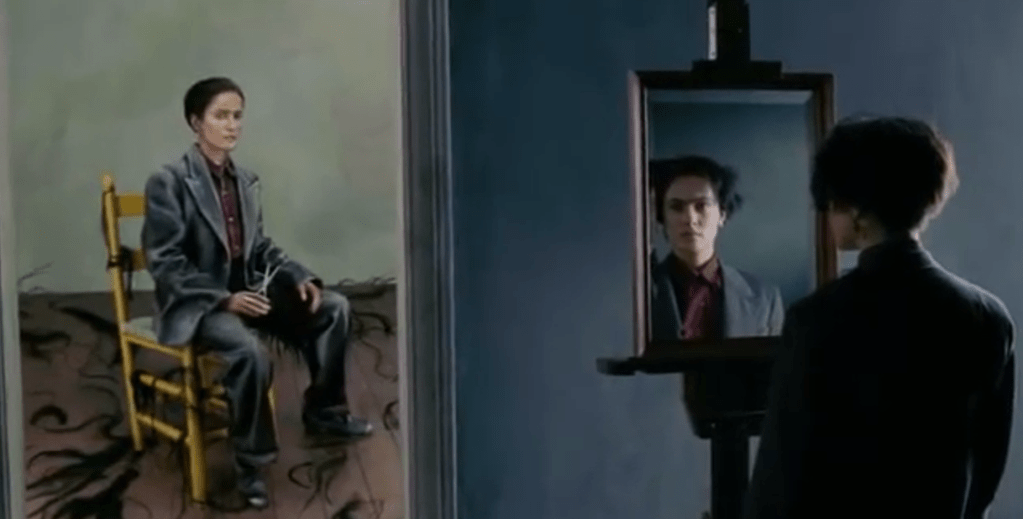
Though Frida is ultimately a story of female artistry and empowerment, it’s important to acknowledge the behind-the-scenes struggles that actress and producer Salma Hayek faced as a woman in bringing this film to life. In a New York Times opinion pieceLinks to an external site., published in 2017, Hayek exposed film producer Harvey Weinstein, a founder and leader at Miramax Films, for years of misogynistic behavior, sexual harassment, and bullying behind-the-scenes of Frida. Not only did Weinstein continuously pressure Hayek into sex, he retaliated when she turned down his advances, demanding she raise $10 million, hastily rewrite the script according to his demands, and secure well-known actors for four supporting roles (all hurdles Hayek miraculously leaped over); even after the film was deep into production, he demanded she film a lesbian sex scene with no significance to the character or plot, an experience so horrifying for Hayek that she had a panic attack on set. Though Weinstein’s abhorrent behavior casts a shadow over the film’s history, Hayek’s perseverance and strength in the face of unrelenting misogyny and abuse is equally important to recognize: in some ways, her journey towards having this story be heard mirrors Frida’s journey towards finding her voice and, even after her death, a lasting audience.
 Mo Kim
Leave a comment