
This spring, I’m taking a Intro to Film class for fun at my local community college! Each week, we’ll be watching and discussing a different film. Since I’m learning about this subject for the first time, I wanted to share what I think about each film here!
Note: this review spoils the film’s ending.
Moonlight traces the coming-of-age journey of Chiron, a gay black child growing up in Liberty City, Miami – and the unlikely mentors and friends who shape his journey towards becoming himself. One pivotal figure is Juan, a neighborhood drug dealer, who finds a young Chiron hiding from bullies and takes him in as a surrogate son: in an interview with WBUR, screenwriter Tarrel Alvin McCraney calls out how popular depictions of black men have allowed people to treat homophobia as an issue limited to certain cultures. Homosexuality and misogyny are not “just something that happens in the black community” because of “those people”; it’s tightly woven into the “American ethos,” no matter your race or socioeconomic background. This is why Juan is such an important part of Chiron’s journey: instead of being the “big, black, drug-dealer thug” audiences may expect, he is the first man in Chiron’s life to show him care and acceptance, whether teaching him to swim in the ocean or affirming his right to be himself, even if others may try to make him feel bad. His characterization and his impact on Chiron highlights the film’s conviction that even in a hostile environment, the gift of compassion can transform the trajectory of somebody’s life.
Unfortunately for Chiron, his upbringing in a working-class black community complicates his journey towards becoming himself: the film highlights this through Chiron’s interaction with other boys his age. When he is younger, the only game to play is soccer (with a makeshift paper ball); anybody who is physically weaker is marginalized as “soft,” something that his friend, Kevin, points out. This theme carries into high school, where campus bully Terrell goads Kevin into beating up Chiron through a game of “knock down, stay down,” a game they apparently loved to play in middle school – which raises the question of how deprived of activities and resources young boys must be to resort to punching each other as a “game.” Finally, when Chiron finally decides to fight back, the immediate punishment is arrest and incarceration, leading him to an adulthood where his prison history limits his employment opportunities and pushes him dealing drugs. For young boys like Chiron, the social rules of this world are clear (be dominant, physically and emotionally; always throw the first punch; never let somebody see you as weak), and Moonlight clearly draws a connection between the poverty in Chiron’s community and the cruel choices they lead young men into making.
Beyond Chiron’s interactions with peers, there’s also his interactions with his mother, Paula, who struggles with drugs throughout the film: many films would reduce her to a neglectful addict, but Moonlight works to approach her character with empathy and understanding. In an interview with Vice, director Barry Jenkins connects his own experiences being raised by a mother struggling with addiction to his experience directing Naomi Fisher on set. As he recalls, “I knew there needed to be one actor who went through the whole thing, and it felt appropriate for that to be the mother figure.” It’s telling that Paula is the only character who shows up in all three acts of the film – her journey takes her deep into the pits of addiction, then pushes her to work to climb back out. Despite the mistakes she makes as a mother, it’s her love for Chiron in the third act (which she admits she does not need him to reciprocate) that pushes him to embrace her and, eventually, Kevin. In this way, Jenkins turns a character who could have been a one-dimensional villain into a catalyst for Chiron’s choice to forgive others and to find a way to move forward in his life.
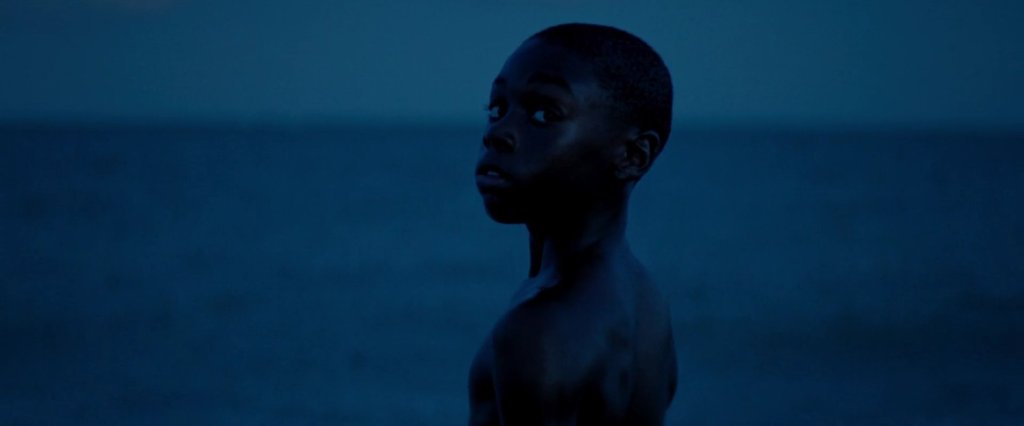
The casting and direction of Chiron’s three actors also helps highlight his evolution over the film. In Jenkins’ words, masculinity (and “black male” masculinity) are “esoteric terms”; he wanted to “see those things represented in flesh and blood” and depict the “evolution” of a person through adolescence into adulthood. This process of casting all three versions of Chiron went beyond physical similarity: in fact, the film deliberately uses contrast to highlight the difference between Chiron’s performed and inner selves. On first glance, Trevante Rhodes (who plays adult Chiron) seems worlds apart from the lanky, shy actors who play him in his younger years; the film highlights his muscular body and depicts him working out late into the night. Yet his mannerisms, particularly around his mother and Kevin, remain unchanged; he is still hesitant to make eye contact, slow to speak, and not completely secure in his own body. In short, Rhodes’ performance and Jenkins’ direction highlight how much of Chiron’s transformation is merely a shell, a way for him to “pass” as a strong man and hide his desire to be “touched” by another person – and it’s only in the film’s ending, where he lets himself be vulnerable with Kevin, that we finally return to the waters where Juan taught him to swim and see the young boy within him come back to life.
It’s in Chiron’s journey back towards his inner child (and towards healing and reconciliation with his authentic self) that Moonlight challenges narrow definitions of masculinity, particularly for black men. Actor Andre Holland makes this explicit in an interview with The Root: he points out how “so much value has been placed on the black body” as a “powerful tool,” making black men scared to reveal vulnerabilities because they want to be perceived as people with “strength, integrity, and dignity.” Yet Holland argues that there are “so many different shades to masculinity and manhood,” including “vulnerability”; both Kevin and Chiron take the entire film to learn this lesson, as they spend most of their adolescence (and even adulthoods) performing versions of manhood they imagine will keep them safe from their deepest secrets and desires. Only when they embrace these vulnerabilities – and each other – do they finally find the strength to be their true selves. Though Moonlight does not end with a definitive victory for either man, it reminds us that it is never too late to be yourself. The water is there. We just need the courage to swim.
 Mo Kim
Leave a comment