
This spring, I’m taking a Intro to Film class for fun at my local community college! Each week, we’ll be watching and discussing a different film. Since I’m learning about this subject for the first time, I wanted to share what I think about each film here!
Note: this review spoils the film’s ending.
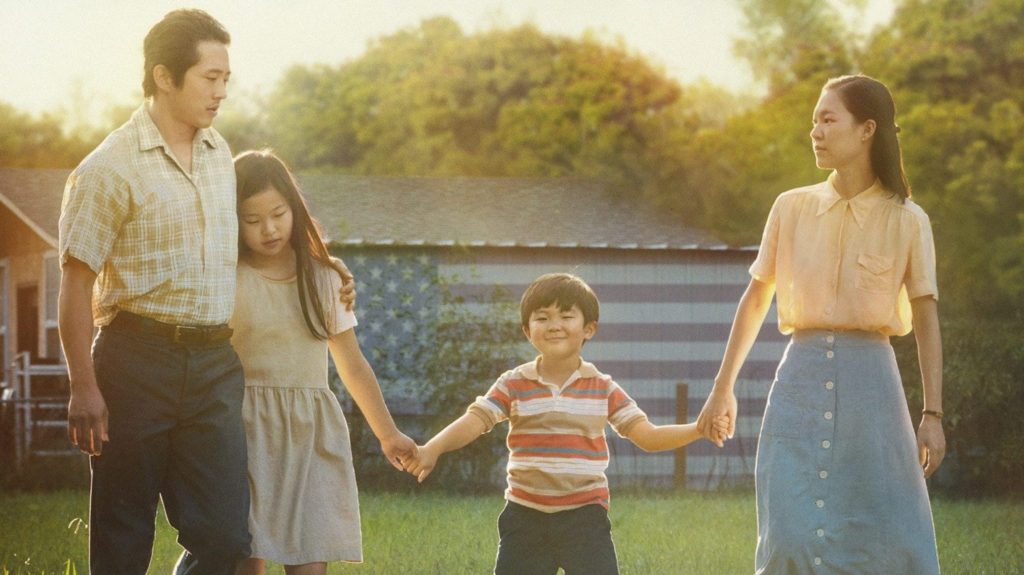
Although Minari begins as a slice-of-life exploration of a Korean family adjusting to farm life in rural Arkansas, it develops into a meditation on the meaning of family – and what it looks like to choose each other.
For most of the film, Jacob, the patriarch, stubbornly focuses on launching his new 50-acre farm, at the expense of his children and marriage; he often snaps at his children, shuts out his wife, Monica when she voices her concerns, and continues to drive their family deeper into debt. Despite his insistence that he’s doing this for his family, his fatal flaw – his prideful desire to prove himself – gives him tunnel vision, preventing him from seeing how he’s putting his dreams before his children and wife’s needs. Meanwhile, his youngest son, David, is struggling with both his heart condition (his parents often remind him not to run) and his uneasy relationship with his grandma, Soonja, who moves from Korea to be with the family. Initially, David and Soonja clash over language barriers, disgusting traditional Korean medicine (which David’s mom forces him to drink every day), and perhaps most important to David, her inability to bake cookies.
But Minari challenges both Jacob and David to reconsider their values and grow over the course of the film. As David spends more time with Soonja, she challenges him to become more courageous and confident: slowly, David starts to find his voice and step beyond his parents’ protection. Meanwhile, Jacob finally succeeded in securing a contract with a grocer…only to find that Monica has finally lost faith in him and wants to end their marriage. This leads into a poetic climax, when they return home to find their barn (with all of their crops) on fire: in the heat of the moment, Jacob and Monica give up on saving their crops and finally decide to save each other. David, on the other hand, sees his grandmother wandering away from the fire, and runs to save his grandmother and convince her to return home. The whole family, exhausted, fall asleep together on the floor of their mobile home: though they may still be broke, they have finally chosen each other. They have survived the worst thing that could have happened and chosen to stay together.
Beyond its depiction of the relationships between different characters, Minari’s titular plant itself highlights the film’s theme of choosing family, even in the face of hardship. The minari plant is essentially an edible weed: as the grandma tells David, you can plant it anywhere and it will grow. For the whole family, this plant may represent their resilience as Korean Americans, able to lay down roots anywhere they find themselves. For Jacob, in particular, the minari plant reinforces his shift away from financial success and towards family: at first, he is an industrial farmer, toiling for hours to grow his crops (and find a market to sell them). In his mind, the minari plant is an unprofitable nuisance, an idea from an out-of-touch old lady that he dismisses with a casual “I’ll think about it”. By the end of the film, however, his hard work has gone up in flames while the minari, planted casually by a creek, have grown by themselves. It’s a symbolic reminder that sometimes, abundance comes not from carefully-cultivated plans but from choosing to live in the moment and prioritize those around you.
Like the minari by the creek, Jacob has grown into a different person by the film’s ending. This is most evident in his body language: for most of the film, Jacob is hunched over his crops or a table of chicks, so stiff after long hours of labor that he can’t even raise his arms over his head. Even at the dinner table, he carries himself like a bomb trying his best not to detonate, arms crossed, his head turned away from everybody else (unless, of course, he’s disciplining his children). It’s only in the fire’s aftermath that we finally see his body language open up, leaning towards his wife as they work with a water provider and receiving help from others for the first time. More importantly, in the final scene, by the creek, that we finally see him at ease: kneeling by the water, slowly harvesting these new plants alongside his son. Though the film closes without indicating whether Jacob and his family will ever find financial success, it does affirm his transformation into a more thoughtful father and husband and the family’s transformation into a united team that can face the future – and grow – together.
 Mo Kim
Leave a comment