
To survive academia, you need ease: the ability to walk through any place, whether a house party or a cocktail reception, with the conviction that you belong and you know how things are supposed to work. Ease may be a product of education, but it’s also a product of wealth, and just as its etymology suggests, it makes things so much easier for those lucky enough to be born rich. It’s why in college, some people feel comfortable applying to internships they don’t qualify for and cold-calling professors for research opportunities, while others struggle gathering the courage to ask a question out loud.
It’s only looking back that I realize how much my lack of ease impacted my college education. As a pastor’s kid from Koreatown, I never expected to attend a school like Harvard, let alone for free, so for most of my undergraduate career I felt the need to prove myself worthy of the opportunity. I took the classic advice: Fake it ’til you make it. Yet no matter how hard I tried to acclimate, it felt like there were hidden rules – to making friends, participating in classes, and building relationships with mentors – that I couldn’t even see. What’s worse is that I was surrounded, at the height of my impostor syndrome, by a student body of incredibly self-assured and well-spoken peers. While I would struggle through readings and choke on my words during seminar, I’d overhear my most talkative classmates confessing that they hadn’t even opened the books they were so fervently debating. In retrospect, I can see through the bullshit; in the moment, all I could do was blame myself. If I can’t hack it here, I thought, it must be my fault. I’m just too awkward, too unsophisticated, too ignorant.
This lack of confidence carried into how I presented myself. Because I didn’t see myself as someone with the privilege or the smarts to succeed, I tried my best to blend into the background during class: when I look at old photos of my baggy T-shirts, over-sized hoodies, and slouched posture, I cringe a little bit. Even so, I can see how this younger me was protecting themselves from the pain they were feeling. They were rejecting academia before academia could reject them.
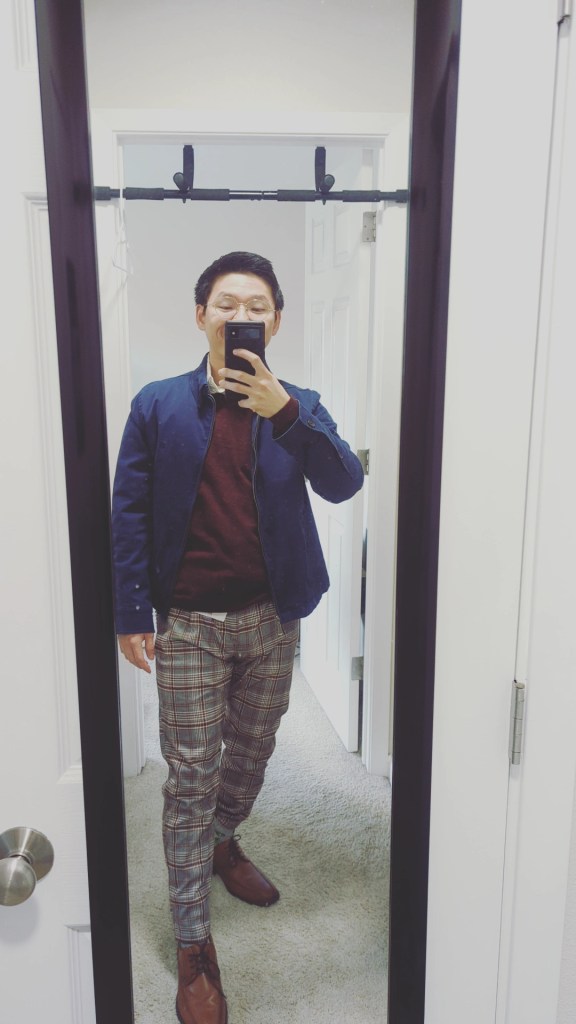
All of which brings me to an ironic revelation: today’s outfit is what I wish I could have worn when I was back in school. It’s the pants I couldn’t afford back when I was picking used jeans off the floor of Garment District; the shoes I saw some of my wealthier peers casually flaunting on their way to frat parties; the sports jacket I told myself I’d wear one day when I was confident enough to pull it off. I wonder who that version of myself – the one staring back at me in the mirror – might have grown to become. I wonder if they would have been happier in college than I was.
But maybe it’s okay that it’s taken me the better part of eight years to reach this point. Maybe I needed to work through the confusion of being a not-quite-first-gen student, an abuse survivor, and a closeted queer kid to find myself; after all, that pain is what eventually led me to start therapy, reach out to my professors more often, and seek friendships where I truly felt respected and valued for who I was. And maybe the knowledge I’ve gained, after years of struggling through my own feelings of inadequacy and alienation, has made me a better educator: someone who can connect with students on a human level and create space for vulnerability and authenticity in our relationships. I am no longer ashamed to admit my lack of ease, because my struggles have helped me realize who I am and what I have to offer the world.
With time, I slowly built a strong network of mentors and friends, where I found the belonging I had so desperately wanted as a freshman; more importantly, I developed the courage I needed to be authentically myself. Even now, I still don’t always feel completely at ease in academic or professional spaces: I still often grapple with the sense that I don’t belong. But I’m slowly learning how to navigate these spaces without faking it. It isn’t easy, but growth never is.
Steal the look:
- Brooks Brothers navy blue jacket (Actually a graduation gift from my dad – and what I wore on my first day of official teaching back in 2018!)
- Slim-fit Oxford shirt, white (Oxfords are nice! They’re a happy medium between casual shirts and fancy-schmancy dress shirt. And they go great with the right jacket or sweater. Speaking of which…)
- Dark red sweater (I prefer wearing relaxed, looser clothing when possible, so a lot of the clothes that feel tighter on me stay in my wardrobe, but the more I push myself to wear them, the more comfortable I’m getting with them.)
- Grey flannel pants (Bought these on a whim during the pandemic, finally finding a reason to wear them!)
- Brown dress shoes (I…don’t love dress shoes. I’d choose sneakers any day of the week. But if you’re going to wear them, make sure you get them in a comfortable fit so your feet don’t lose all feeling.)
Coming tomorrow: We’re getting nautical!
 Mo Kim
Leave a comment